Wednesday, December 10, 2008

Top Exhibits of 2008. ORLY?

            This week, Time Magazine and CNN published their Top 10 of Everything for 2008. Included in this myriad of lists was the “Top 10 Museum Exhibitions of 2008.” The 10 exhibits chosen are:

  •  Sol LeWitt: A Wall Drawing Retrospective – MASS MOCA
  •  Gustave Courbet – The Met 
  •  El Greco to Velazquez: Art during the Reign of Philip III – MoFA Boston
  •  Terra Cotta Warriors and the First Emperor – The Bowers and the High
  • Moore in America – NY Botanical Garden
  • Louise Bourgeois – Guggenheim and LA MOCA
  • Kirchner and the Berlin Street – MOMA
  • Bernini – The J Paul Getty Museum/Nat’l Gallery of Canada
  • Tara Donovan – Institute of Contemporary Art, Boston
  • William Eggleston: Democratic Camera – Whitney Museum of American Art

             I have not seen these exhibits, by virtue of economics, time and geography. It would be unfair for me to make judgments on them by virtue of a small photo and a short review in Time Magazine. Nevertheless, I will now proceed to lump them into a group and talk about them.

             All ten exhibits are art exhibits of some sort (One could argue that the Terra Cotta Warriors exhibit is a cultural/ethnographic/history exhibit, but it is presented as art). The brief write-ups on each exhibit focus on the content, and on the importance of the artist/culture, rather than the exhibition itself.   It would seem these shows are large – words like “monumental,” “exhaustive,” and “sizeable” pepper the reviews. 

             I would assume, unfairly perhaps, but experience dictates my assumption, that these exhibits are completely object centered, with little to no interactivity. I imagine them littered with lengthy text panels and dense quotes from the curator. I imagine that the point of the exhibit was to highlight the tremendous work done by the artist. And I imagine that for the most part, these exhibits are well outside the comfort level of potential visitors.

             In effect, all of these shows continue to lend credence to the idea of the museum as an impenetrable ivory tower, where the masses come to learn from the learned curators.  I wonder if, and indeed hope that, the top 10 list is not based on audience feedback, earned revenue, visitation, blog posting, etc, but rather on the opinions of a small group of art critics at Time and CNN. It seems more than likely. However, the public does put trust in the recommendations of art critics at such media institutions as The New York Times, the Wall Street Journal, and Time Magazine. If the well-educated critics there think an exhibit is exceptional, it must be so, right? So, I should visit these exhibits if I can, and will try to make myself seem brilliant and cosmopolitan. Even if I really don’t get it.

             And now we find ourselves in a cycle. Museums produce more of the same – object centered exhibits, as opposed to visitor centered ones. Even Time notes that the Coubert exhibit was “old fashioned,” albeit “in the best way — rich, thorough and smart.” So, old-fashioned exhibits are lauded in the press, which gets the attention of donors, visitors, board members, etc. So if Museum A has earned kudos for this sort of exhibit, why couldn’t it work for Museum B? All the while the Community Museum of XYZ is producing groundbreaking programs and exhibits, but is all but invisible to the world at large.

            It brings back to mind the “chain” museum. These 10 exhibits are so homogeneous that they could all be on exhibit at any of the 10+ museums mentioned. There is nothing about any one of these exhibits that speaks to a specific space, community or audience. These are McExhibits. I can only hope that the smaller museums of the world begin to experience the resurgence that “mom and pop” style diners have, or boutique shops and hotels. Wouldn’t it be nice to see one of these on the top 10 for 2009?

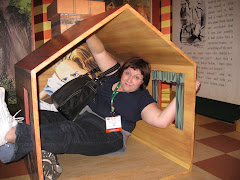
AWESOME!

http://jumpinginartmuseums.blogspot.com/

Things like this make me happy. I wish the people sending in photos also sent photos of the reaction from security.

Can we jump in other museums?? Is this a worldwide movement waiting to happen?

Thursday, December 4, 2008

Focus. Focus.

Divergent thinking -

Excellent for class discussion, riffing on a topic over a beer, and exploring the ideas of a book or paper.


TERRIBLE for writing a coherent piece on one topic.

Beating my head against a wall. Over and over. 

Tuesday, December 2, 2008

Long time no post

I was so good about posting for a while, then nothing. Ah well, I blame finals and the holiday crunch. Hard at work on this paper on design and critical thinking; knee deep in new museology concepts. I'm having a hard time organizing thoughts, and am afraid this may get away from me... 

I tend to get so deep in research that I lose focus, so I am trying to keep things pointed to one topic. I can always go back to explore later if I want. Especially as I am a one class lady next semester. 

Thinking about subtle and overt politicization of exhibits. What got me thinking about it is comments I have heard about the fetal development area in Bodies/Body Worlds. Almost chapel like - set apart, with recumbent Madonna-like female body. Takes the viewer from a scientific and clinical frame to a spiritual one. Is this subtle politicization? Is that even a word? I cannot help but think that the presentation speaks to the pro-life movement and puts off the message of "the miracle of life." 

I am trying to come up with other examples. Obviously many museums have subtle or overt celebrations of militarism, but what else? And, does it make a difference if it is, say, the Spy Museum's Terror exhibit versus an exhibit from a non-profit? I'm especially interested in exhibits that are not intended to be political, but become so by nature of their physical presentation. 

If anyone is reading this, and has examples, I'd love to hear them.

Thursday, November 6, 2008

Dr Jekyll and Mrs Hyde

Sometimes I feel like I am two people, museum-wise. Take today for example. Between the AAM webinar on Excellence and Equity and class tonight, I spent about 7 hours thinking about audience advocacy, civic dialogue, the role of education, etc. All good, soul-edifying things.

But I also spent several hours working on things to drive revenue, and ways to get parents to pony up cash for premium experiences.

And I should probably feel bad about that, but I really don't.

So, I guess what I am wondering, is this: Is it ok to play both roles? Can you advocate for audiences and still play the business angle? I think my response is yes.

I sometimes feel like a broken record in class. When in a classroom full of students and often professors for whom museum work is largely still theorhetical, I feel I need to remind them that museums are an odd combination of business and educational/cultural institution. People always seem to forget the business end of things.

The modern museum is constantly faced with a need to compete for your constantly decreasing free time. We need to keep you coming in the doors. LIke it or not, the money you give to museums, through tickets, donations, retail and food service, helps us not only keep the doors open, but care for collections and continue our mission.

So how do I reconcile championing things like photo sales and face painting - and charging for them- with my passion for audiences and education? It's not always easy. I almost have to be two people, part savvy businesswoman who looks at theme parks and malls and says "what a great idea!" and part subversive educator who looks at websites and tiny museums and library programs and says "what a great idea!" When I am lucky, the two things meet up. When I am not, they juxtapose in ways that are uncomfortable.

I cannot say that I am sorry for thinking of ways to generate revenue. It is not my intention to nickle and dime visitors. I can only hope that what we are coming up with is an experience that is beyond a simple retail transaction. I hope that I manage to balance the two sides of my personality.

Anyone out there have similar experiences? Or thoughts?

Wednesday, October 15, 2008

How can your museum help end poverty?

Today is Blog Action Day. The topic is poverty. Blog Action Day is about getting bloggers to discuss one issue, to change the conversation and get people talking. I'm so on board with that. So a celeb blog (like Perez, which yes I read, don't judge me) could discuss Brangelina and others who are attempting to make a difference in the world.  A blog about politics can discuss policies and such that can help. But what can a blog about museums discuss?

Much is made of the importance of museums to society. Museums provide a place for contemplation of aesthetic wonder, for learning about the past, and for imagining the future. Ideally, museums provide resources to the community, educate citizens and offer opportunities for engagement with others. But can museums help alleviate basic problems? Can museums have an impact on poverty and hunger? You all know the answer - of course they can!

So, here are some ideas, off the top of my head...with some links.

The Tenement Museum has amazing community programs that help address poverty through dialogue and education. The most powerful programs  target school children. One program leads students through a discussion of class bias, and another teaches about substandard housing, and encourages students currently living in substandard conditions to report violations to the housing authority. These programs empower people to seek ways out of the cycle of poverty and oppression. 

The Workhouse, in the UK, chronicles a solution from the past.  While many of us would shudder at the idea of the workhouse today, we cannot forget that the minds behind the idea meant well.  Programs help visitors relate past and contemporary issues of poverty and welfare. 

One program idea I've had for a while would involve working with groups like Spatulatta or Young Chef's Academy to teach kids and families to create easy, healthy, cheap meals. Food is expensive, and increasingly so. Parents dont have time or energy to cook. My own spouse grew up with this model. Mom's tired from working overtime. Food is expensive, and there are only two of them, so, its cheaper and easier to hit McDonalds than to make a meal. The problem there is that you set up kids for a lifetime of drive-thru dining - which leads to nutritional deficiencies, high cholesterol, diabetes, obesity and overall poor health. Museums, while teaching basic nutrition, should help teach families about budgeting, cooking small meals that can be reheated, and making healthy snacks. They should help families embrace local markets and learn to clip coupons.

In the same vein, many museums are located in urban areas, but areas with green spaces. Most museum campuses have some sort of green space available. How great to turn an unused patch of land into a community garden? Families can work their patch to plant veggies that they can then harvest and eat. Too many tomatoes? The museum can teach the science of canning or freezing. Or better yet, partner with a food bank and donate the proceeds. 

Many museums host resource fairs. The Children's Museum of Indianapolis hosts an annual back to school festival. This festival offers visitors a chance to have vision and hearing screenings done, as well as get basic immunizations. All at low or no cost. In addition, we partner with Backpack Attack to distribute school supplies to over 20,000 children in our local area. 

Offer classes - as a children's museum we tend to focus on kids, but parents need classes too. We have recently begun hosting basic finance classes. We also host computer classes through our local library branch. Offer babysitting certification. Teach parenting skills to young parents. Offer resources for foster and adoptive parents. Offer opportunities and respite for those caring for elders. 

Discounts - no one should ever be barred from your museum because they cannot pay. If they will not, thats one thing, but if they truly want to come, there should be a way. Offer programs, opportunities, free days, etc, to allow everyone to have access.

Most importantly though, museums can help by working at the roots of poverty. Help your visitors understand that poverty affects people in every city in the world. Help children and families recognize consumerism and the problems it causes. Help them understand that people living in poverty are not lazy, nor are they stupid. Help them understand that barriers to education cause a cycle to exist. Stop promoting the "pull yourself up by your bootstraps" mentality that if you want something enough you can do anything.  Stop promoting the myth of the meritocracy. Start the conversation about why this isnt true. Help visitors appreciate the opportunity to learn, to get good health care, and to have a hot meal and warm bed. Help grow compassion and understanding. Help them name the prejudices and biases that keep people locked in poverty. Help empower them to seek justice and stand up to those who would keep the cycle of poverty going.  Show examples from the past and connect them to the present and future. Bring about understanding.

Museums educate. That's what we do. We can host free nights and give things away until we are blue, but unless we educate people - both those in poverty and those who believe they will never be touched by it (especially those who believe they will never be touched by it) then we will not break the cycle.

OK, soapbox done. Carry on.


Tuesday, October 14, 2008

Blog Action Day, 08

Tomorrow, October 15, is Blog Action Day. The topic for 2008 is poverty. What to write about? I've a few ideas percolating. We'll see what comes out, eh?